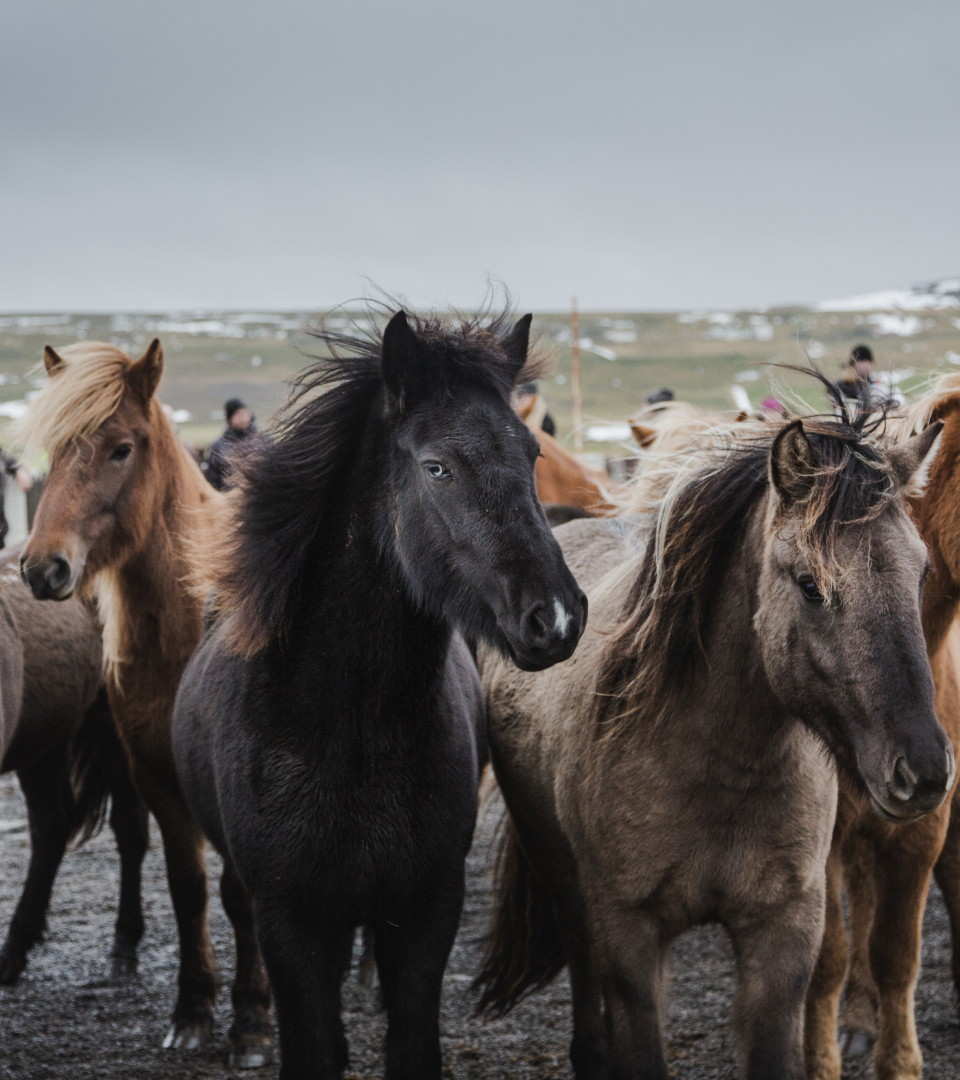
Correct hoof care from a good farrier is an essential part of the care of any domesticated horse. Horses’ feet grow much like human nails, and just as we cut our nails, hooves need to be trimmed in order to keep them healthy, especially as the hooves carry the weight of the entire horse.
In the wild, horses' feet would be naturally trimmed, or eroded, by the ground and rocks as they roam over. Domesticated animals often spend a lot of time on soft surfaces, with their feet becoming frail, uneven and too long as a result and growing, causing pieces to break off and the hoof to crack. If this happens, the horse is likely to become lame.
Wild horses with bad feet would be whittled down by natural selection, whereas domesticated horses can pass along the genes that create weak or poorly shaped hooves.
Horses' feet need to be cared for right from the outset. Good trimming on a foal can prevent or improve many limb imbalances, improving the horse’s leg conformation and movement.
Horses should be trimmed every six weeks throughout their lives, and working horses are usually shod to protect their feet and allow for the use of studs to improve grip.
Once a horse has shoes on, the farrier will trim the hooves and refit or replace the shoes every visit, depending on wear. Feet continue to grow with shoes on, so a frequent farriery schedule is very important. Feet should be picked out every day to remove mud or surface and prevent infection.
Horseshoes come in a variety of materials, including steel, aluminium and rubber. Shoes are usually nailed onto the hoof into the insensitive laminae of the foot. In some cases, the farrier may decide to use specialised glue instead.
Some horses never wear shoes. If a horse has tough, well shaped hooves that are inclined to grow correctly and the horse’s activities don't require special shoes for support – such as roadwork – the horse may not need to be shod. The hooves will still need trimming every six weeks or so. Much depends on the conformation of the horse's feet and legs as well as the type and level of work.
Hoof balance is an extremely important aspect of foot care. Hoof balance is measured using a hoof gauge that measures the angle of the of the hoof wall in relation to the ground. A rough guide for correct angle of the front feet is 45 to 50 degrees. The line drawn up the hoof wall should be the parallel with that of the pastern and the heel of the foot too.
The hind feet are naturally more upright, and should have an angle of 50 to 55 degrees. These angles are also referred to as the foot-pastern axis.
Though the above is used as a good rough guide as to what is ideal, every horse is different, and the primary role of the farrier is to keep the horse free of foot problems that could cause lameness. Thus a good farrier may trim or shoe a horse in a way that does not appear textbook, as that horse’s conformation will not allow for it to be treated in a textbook manner.
Correct farriery can prevent foot problems and associated issues, such as long toes and heels that could lead to tendon problems and lameness.
Be sure to read H&C's exclusive blog by farrier Nigel Brown.
| 1:00am | Badminton 2011 - Cross Country |
| 6:00am | The Saddle Club |
| 6:30am | The Saddle Club |
| 11:00am | Wonder Dogs |
Advertisement
Advertisement

About Us | Advertising Info | Contact Us | Help | Terms of Service | Privacy Policy | Sitemap | Feedback
© H&C TV Ltd 2008-2012